
Builders work 30% faster
20% on Wonders. The only bonus that helps you in the Dark Age — it makes walling quicker, tower rushes viable, and, crucially, gets your first Castle up meaningfully sooner than anyone else's.

Almost every Spanish bonus arrives after minute sixteen. No Crossbowman, no early economy edge, and then a Castle Age Conquistador that many players consider the strongest unit of that age. This guide leads with the Fast Castle Conquistador Spanish build order on Arena, covers two more openings, explains why the Spanish Monk and Missionary are among the best in the game, and takes in the tech-tree gaps, the El Cid campaign and how much of it matches the real Spain.
What you actually get
Five bonuses, and only one of them does anything before the Feudal Age. That single fact explains both why the Spanish struggle on open maps and why they are frightening on closed ones.
20% on Wonders. The only bonus that helps you in the Dark Age — it makes walling quicker, tower rushes viable, and, crucially, gets your first Castle up meaningfully sooner than anyone else's.
Every attack and armour upgrade costs food only. On a civilization whose entire army is gold-hungry, that gold stays free for Conquistadors and Paladins instead.
Hand Cannoneers, Bombard Cannons and Cannon Galleons. Bombard Towers are excluded. It is a reload reduction of roughly 15%, which is why Spanish gunpowder feels quicker than the stat sheet reads.
A newer bonus that quietly rewards the way Spanish games actually go. On a long closed-map game where you research nearly everything, it adds up to a substantial gold rebate.
Unique unit
A mounted Hand Cannoneer: heavy damage, poor accuracy, a bonus against buildings, and the speed to hit and run. Widely rated the strongest unit in the Castle Age — and honestly weaker in Imperial, when its counters all improve at once.
Trains at the Castle · mounted gunpowder
Second unique unit
A Monk on horseback — faster, tougher, shorter range. It no longer needs a Castle to train, Husbandry now increases its speed, and it heals at the same rate as a foot Monk. It keeps pace with a cavalry army in a way a walking Monk never could.
Trains at the Monastery
Castle Age unique tech
Monks and Missionaries convert faster, and Missionaries gain +1 range. The cost was cut long ago from 400 food and 400 gold to 100 food and 300 gold, which is what makes a Missionary push affordable at all.
100 food · 300 gold
Imperial Age unique tech
Villagers gain +40 hit points, +6 attack and +2/+2 armour. Combined with 30% faster building it lets villagers work at the front line — throwing up forward Castles and towers under fire, and finishing off a siege themselves.
400 food · 250 gold
Team bonus
For you and every ally, and widely considered one of the best team bonuses in the game. It is the main reason Spanish are a strong team-game pocket pick even when their 1v1 record is ordinary.
Applies from the start of the game
The unique unit, in numbers
A gunpowder unit on a horse, which means it inherits both sets of counters. Understanding which ones apply is the difference between the best Castle Age unit in the game and a very expensive mistake.
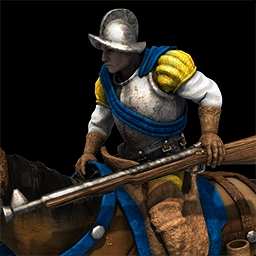
Castle Age · trains at the Castle
Mounted gunpowder · bonus vs buildings
High damage, low accuracy, fragile.
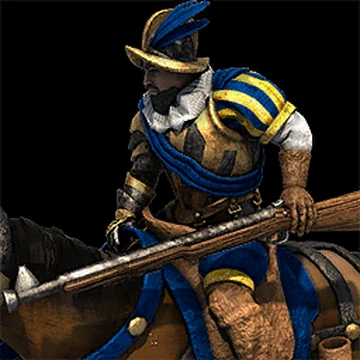
Imperial Age · Elite upgrade
Still fast, still fragile
Upgrade early — its counters improve faster than it does.
| Property | Conquistador | Notes |
|---|---|---|
| Unit class | Mounted gunpowder | Counts as cavalry and gunpowder |
| Accuracy | Low | Like a Hand Cannoneer |
| Bonus damage | vs buildings | Can help break a base |
| Mobility | Mounted | Hit-and-run is mandatory |
| Durability | Fragile | Screen with Knights or Paladins |
| Anti-cavalry-archer damage | Takes it | Changed in DE — Skirmishers and Genitours now hurt |
| Peak | Castle Age | Falls off in Imperial |
| Trains at | Castle | Builds 30% faster for Spanish |
The Definitive Edition change most guides miss: Conquistadors now take anti-cavalry-archer bonus damage. That means Skirmishers, Camel Archers and Genitours all counter them, which was not true in earlier versions — and it is why a Conquistador mass that would once have run over an opponent can now evaporate against cheap trash units. They remain devastating against slow melee: infantry, Rams, Battle Elephants and Boyars all struggle to ever touch them. Never let them stand and trade, always screen them with Knights, and upgrade to Elite as early as you can afford it.
Infantry of every kind, Rams, Battle Elephants, War Elephants and Boyars — anything slow and melee. Also useful against buildings, which lets them contribute to a siege.
Skirmishers, Genitours, Camel Archers, Halberdiers, Camels, Mamelukes, Huskarls and Genoese Crossbowmen. Siege Onagers, massed Scorpions and Bombard Cannons punish them badly if you stop microing.
The second half of the civilization
The Spanish are officially a gunpowder and Monk civilization, and players routinely forget the second half. Every monastery technology is available, Inquisition speeds conversion on top, and the Missionary gives you a Monk that can actually keep up with cavalry.
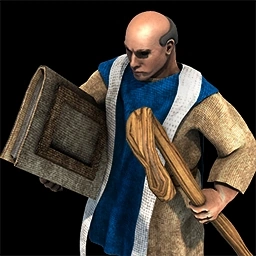
Castle Age · trains at the Monastery
Full range · carries relics
Every monastery technology available.
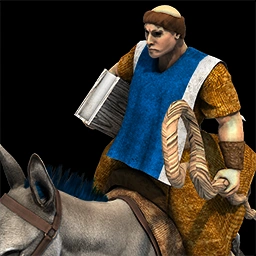
Castle Age · no Castle required
Mounted · faster, shorter range
Gains speed from Husbandry.
| Property | Monk | Missionary |
|---|---|---|
| Movement | On foot | Mounted, much faster |
| Conversion range | Full | Shorter |
| Durability | Low | Higher |
| Husbandry | No effect | Increases speed |
| Requires a Castle | No | No longer |
| Counts as | Monk | Monk and cavalry |
| Inquisition | Converts faster | Converts faster, +1 range |
| Healing rate | Standard | Same as a Monk |
Why the Spanish Monk matters more than it looks. This civilization has no Crossbowman and no Halberdier problem-solver in the Castle Age, so conversion is a real answer rather than a luxury — a converted Paladin or War Elephant is the cheapest unit you will ever field. Inquisition costs 100 food and 300 gold, down from the 400/400 it originally cost, which is what makes a Missionary push affordable at all. Pick the Missionary when your army is mounted, which for the Spanish it usually is: it keeps pace with Conquistadors and Knights instead of trailing three screens behind. Pick the foot Monk when you need the extra range, or when you are collecting relics. Bear in mind the Missionary is classed as cavalry as well as a Monk, so Halberdiers, Camels and Eagle Warriors all threaten it.
Paladins, Knights, elephants and anything else expensive with low conversion resistance. Against Franks, Persians, Khmer and Burmese, conversion swings whole fights.
Light Cavalry, Eagle Warriors and enemy Monks. Missionaries must get closer than a foot Monk to convert, which puts them inside archer range — and Heresy makes your conversions temporary.
Honest assessment
A civilization with almost no early game and almost no late-game holes. Every Spanish decision comes down to buying time cheaply enough to reach the part where you are stronger.
The Arena build first, then two more
The Fast Castle Conquistador on Arena is the definitive Spanish build — walls remove the early-game problem entirely and hand you straight to the part where the civilization is strong. The other two cover open maps and the tower rush their builder bonus makes possible. Villager numbers are cumulative — villager 11 is your eleventh, counting the three you start with.
Villagers 1–6
Two houses, then all six to sheep. On Arena you are safe behind the wall, so scout your own area for boars, berries and both golds rather than looking for the enemy.
Villagers 7–10
To wood with a Lumber Camp.
Villager 11
Lure the first boar under the Town Center.
Villager 12
Build a house, then a Mill on berries. Your builders work 30% faster, so every one of these buildings costs you less villager time than it costs your opponent.
Villagers 13–14
To berries, alongside the villager who finished the Mill.
Villager 15
Lure the second boar. Push deer if any are close.
Villagers 16–18
Berries and food under the Town Center.
Villagers 19–22
To wood with a second Lumber Camp. Arena is forested, so wood is plentiful — take advantage.
Villagers 23–26
To gold with a Mining Camp. Put four on it, not two. Conquistadors are expensive and you want production running the moment the Castle finishes.
Feudal Age
Research Loom, then click up at around 27 pop. Build Market and Blacksmith with two wood villagers while advancing, and click Castle Age as soon as you land.
While advancing
Take blacksmith upgrades freely — they cost no gold for you, only food. Every technology you research also refunds +20 gold, so researching is quietly cheaper for Spanish than for anyone else.
Castle Age · ~16:30
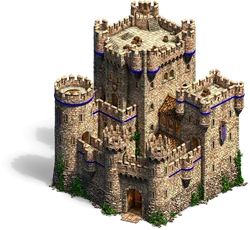
Castle immediately. This is the pivot of the whole build, and the 30% builder bonus means it goes up faster than your opponent expects. Put four or five villagers on it.
Production
Continuous Conquistadors from the Castle. Add a second Town Center, then Wheelbarrow. If the opponent is on infantry, you have already won the matchup — Conquistadors devastate anything slow and melee.
Support
Add Knights to screen the Conquistadors, and a Monastery for Missionaries. Take Inquisition if you commit to conversion — at 100 food and 300 gold it is far cheaper than it used to be.
Why Arena solves the Spanish problem completely: everything wrong with this civilization happens before minute sixteen — no Crossbowman, no economy bonus, no military bonus. Arena deletes that phase. Behind walls you reach the Castle Age untouched, and then you field the unit most players consider the strongest of that age, backed by free blacksmith upgrades and a Castle that went up 30% faster than anyone else's would. Two things to get right: put enough villagers on gold before you age up, because a Castle with no Conquistadors coming out of it is a wasted 650 stone; and screen the Conquistadors with Knights, because they are fragile and every Skirmisher on the map now does bonus damage to them.
Villagers 1–6
Two houses, then all six to sheep. Scout properly — on an open map you need to know what is coming, because you have no cheap answer to most of it.
Villagers 7–10
To wood with a Lumber Camp.
Villager 11
Lure the first boar.
Villager 12
House, then a Mill on berries.
Villagers 13–16
Berries, then the second boar. Start walling with spare villager time — your 30% bonus makes palisades genuinely quick, and this is the bonus doing real work.
Villagers 17–20
Food under the Town Center and farms. Build the Stable with a wood villager.
Villagers 21–22
To gold with a Mining Camp.
Feudal Age
Loom, click up at ~22 pop. Scouts as you land — three or four, purely to deny map control and delay the opponent.
The awkward middle
Add Spearmen and Skirmishers as needed. Do not build Archers as a main force: they can never upgrade to Crossbowman, so every minute you invest there is wasted. Finish your walls.
Castle Age
Click up behind the walls, then Castle and Conquistadors, with Knights alongside. Blacksmith upgrades are free of gold, so take them all.
Imperial
Elite Conquistador, Paladin, Hand Cannoneers and Bombard Cannons. Take Supremacy if the game is going long — villagers that fight let you build forward under pressure.
Be honest about what this build is: survival. On Arabia the Spanish have no Feudal Age power spike and no cheap ranged unit, so Scouts and walls exist purely to reach the Castle Age at all. The build is rated hard for that reason — not because the execution is complex, but because you are behind on tempo the entire way and one mistake ends it. The reward is that once your Castle is up, you have Conquistadors and your opponent probably does not have a good answer.
Villagers 1–10
Standard opening — sheep, then four to wood. Scout early and hard: this build only works if the opponent is close and their resources are exposed.
Villagers 11–15
Boars and berries. Keep stone in mind from here — you need it earlier than a normal build.
Villagers 16–19
Put three or four on stone. Each Watch Tower costs 125 stone, and you want at least two.
Feudal Age
Loom, click up at around 21 pop. Send two or three villagers forward while you are still advancing so they arrive as you land.
The tower
Build Watch Towers on their gold or wood line. This is the entire point of the build: your villagers put them up 30% faster than any other civilization's, which is often the difference between the tower finishing and the tower being killed half-built.
Follow-up
Add more towers as you push in, and garrison villagers for extra arrows. Bring a few Spearmen or Scouts to stop their villagers simply walking away and rebuilding elsewhere.
If it works
Transition straight to Castle Age and Conquistadors off the lead you built.
If it fails
You are a long way behind with no economy bonus to recover with. Wall immediately, take the Fast Castle, and accept a defensive game.
A real option, but know the risk. The 30% builder bonus is the only thing that makes a Spanish tower rush better than anyone else's, and it is a genuine edge — towers land before the defender can react. But Watch Tower hit points were reduced in the Dark Age, the build commits stone you would otherwise spend on your Castle, and the Spanish have the worst recovery in the game if it fails, because nothing in their tech tree helps you climb back. Play it when you scout a close opponent with exposed resources, and not otherwise.
Watch the build order run
A Fast Castle build order merged with the Spanish Conquistador rush, walked through step by step. Useful alongside the Arena tab above: this page gives you the villager order to read, the video gives you the execution and the timings to copy.
Spanish build order · Fast Castle into Conquistador Open on YouTube
Playing the civ, age by age
Every Spanish game has the same shape: get to the Castle Age intact, spike hard with Conquistadors, and then convert that into an Imperial Age where you have almost no weaknesses left.
Age I–II
~10:57 – 19:10
You have no military bonus and no economy bonus, so stop looking for a power play that is not there. Wall, using the one bonus that does work — 30% faster builders makes palisade going up quickly and cheaply in villager time.
Do not invest in Archers. They never upgrade to Crossbowman, so every arrow you make in Feudal is a dead end. Scouts, Spearmen and Skirmishers buy time; Archers waste it.
Age III
~19:10 – 28:00
This is your window and it is a big one. A Castle goes up 30% faster for you than for anyone else, and what comes out of it is arguably the strongest unit of the age. Screen Conquistadors with Knights and never let them stand still.
Take every blacksmith upgrade — they cost you no gold at all. Add a Monastery for Missionaries, which keep pace with cavalry in a way foot Monks cannot, and Inquisition if you are committing to conversion.
Age IV
28:00 +
The Spanish Imperial Age has almost no holes. Paladins, Elite Conquistadors, Hand Cannoneers and Bombard Cannons, with gunpowder firing 18% faster than standard. Upgrade Conquistadors to Elite early, because their counters are improving faster than they are.
Supremacy is the sleeper technology: villagers with +40 hit points, +6 attack and +2/+2 armour can build forward Castles and towers under fire and finish a siege themselves. And unlike most gunpowder civs, you do not collapse when the gold runs out — Halberdier, Elite Skirmisher and Hussar are all fully available.
Any age
Scouting notes
Attack early or lose the chance. Before the Castle Age the Spanish have no bonuses at all and no Crossbowman to defend with. Aztecs, Huns, Magyars and Goths all get free rein against an unwalled Spanish player.
Against Conquistadors, cheap trash works better than expensive units: Skirmishers now do bonus damage to them, as do Genitours and Camel Archers. Add Halberdiers and Camels, and bring siege — Siege Onagers and Scorpions punish an unmicroed Conquistador ball. Their Bombard Cannons are exposed to Light Cavalry and Eagle Warriors.
Watch it on the hardest map
The matchup that shows the civilization's real problem. Arabia is where the Spanish are weakest — no Crossbowman, no economy bonus, nothing before the Castle Age — and the Mongols are fast, mobile and happy to punish exactly that. Worth watching for how a top player buys the time the Conquistador needs.
1v1 Arabia · Spanish vs Mongols Hera vs Sebastian Open on YouTube
What you can and cannot build
Strikethrough entries are what the Spanish do not get. The list is short, and one item on it shapes the entire early game: they are one of only two civilizations that cannot research Crossbowman.
Only the Spanish and Bulgarians cannot upgrade Archers to Crossbowman. Treat the Archer as a unit you never build; the Skirmisher line is fully available and is the one to use.
Every upgrade available, and every one costs food only. Over a full game this is one of the largest effective gold bonuses in AoE2.
Full cavalry and full infantry. Paladins screen Conquistadors, and Halberdiers plus Hussars are why the Spanish trash war is unusually strong.
Average rather than bad. Faster-firing Bombard Cannons do most of the work, but they need escorting against Light Cavalry and Eagle Warriors.
Every technology plus Inquisition, and the Missionary as a mounted alternative that no longer needs a Castle to train.
All of it, firing 18% faster. Bombard Towers are the one exception to the speed bonus.
A complete navy, and Cannon Galleons that benefit from Ballistics fire faster and far more accurately at moving targets. Missing Heated Shot leaves shorelines exposed.
The tree is complete but there is no economic multiplier anywhere in it. Faster builders and Supremacy are the substitute, and both are situational.
Where the Spanish appear
Six scenarios following Rodrigo Díaz de Vivar, narrated by his widow Jimena of Asturias shortly after his death. It is the first campaign in the game to switch the civilization you play: scenarios one, two, five and six are Spanish, while three and four are Saracen — because El Cid genuinely fought for both sides.
Scenario 1 · Spanish
1072 · Battle of Golpejera
The old king's realm has been split between his sons Sancho and Alfonso. El Cid begins on foot in a tournament, mounts partway through, and is then sent to capture Alfonso and bring him in for negotiation.
Tip: This is the earliest engagement where El Cid is reliably recorded in command, and probably where he earned the title Campeador. Historically he won it by leading a charge that broke the Leonese cavalry.
Scenario 2 · Spanish
Toledo
Now serving King Alfonso, El Cid is ordered to put down a revolt in the city of Toledo — the beginning of the political entanglement that eventually costs him everything.
Tip: Note the title. The campaign is consistently more interested in shifting alliances than in a clean Christian-versus-Muslim framing, which is unusually faithful to the period.
Scenario 3 · Saracens
Banishment from Castile
Alfonso exiles him, and the campaign switches you to the Saracens. El Cid takes service with Muslim rulers, which is exactly what the historical Rodrigo did.
Tip: A different civilization means a different tech tree — do not carry your Spanish habits across. You are playing a different army for two scenarios.
Scenario 4 · Saracens
The Almoravid invasion
Still Saracen, now facing the Berber invasion from North Africa that reshaped the peninsula and set up the campaign's final act.
Tip: The second and last Saracen scenario. From here you return to the Spanish for the remainder.
Scenario 5 · Spanish
1087–1094 · Taking Valencia
Exiled a second time, El Cid gathers Christian and Muslim followers alike and carves out a territory of his own, ending as ruler of Valencia. The scenario runs through Denia, Count Berenguer, and a Wonder you must defend while it is built.
Tip: If you take the alternative route, the Definitive Edition requires you to set your stance with Denia back to Ally before victory will trigger. It is easy to miss.
Scenario 6 · Spanish
1094–1102 · The Almoravids at Valencia
The finale, built on the repeated Almoravid attempts to take Valencia and on the legend that El Cid won his final battle after he was already dead — his body strapped upright to his horse to lead one last charge.
Tip: That last part is legend rather than record, and the campaign leans into it deliberately. The cutscene art uses oranges throughout, a nod to Valencia's groves.
Design versus record
The Spanish civilization spans roughly five hundred years and two different worlds, and the seams show. One anachronism is so obvious the game's own wiki flags it.
In the game
Mounted gunpowder units appear from the first scenario onward, set in 1072.
In history
Firearms were not used in European warfare until the fourteenth century, and the conquistadors themselves belong to the sixteenth. Putting them in an eleventh-century Castilian campaign is the single largest anachronism in the game, and the series wiki notes it explicitly.
Verdict: knowingly wrong, and the campaign is better drama for it.
In the game
The campaign switches your civilization mid-way, with El Cid serving Muslim rulers.
In history
Rodrigo Díaz really did serve Muslim rulers after his exile, and his followers at Valencia included both Christians and Muslims. Even his title comes from the Arabic sayyid, meaning lord. A game from 1999 declining to flatten the Reconquista into a religious war is a genuinely good call.
Verdict: the best-handled piece of history in the campaign.
In the game
The Castle Age unique technology, making Monks and Missionaries convert faster.
In history
The Spanish Inquisition was established in 1478, mainly to investigate the sincerity of Jewish and Muslim converts to Christianity. Naming a conversion-speed technology after it is bleakly apt: the historical institution existed precisely to police conversions that had been coerced.
Verdict: historically pointed, whether or not the designers intended the edge.
In the game
Every attack and armour technology costs food only.
In history
If any bonus should evoke Spain, it is gold and silver — the bullion from Potosí and the Americas reshaped the European economy and funded Habsburg armies for a century. Modelling that as a discount rather than as income is a curious choice, though the newer bonus granting gold per technology gets closer.
Verdict: the right theme, expressed backwards.
In the game
A second unique unit that converts on horseback and keeps pace with cavalry.
In history
Franciscan and Dominican friars accompanied the conquest and colonisation of the Americas, and missionary work was inseparable from Spanish imperial expansion. Mounted friars keeping up with a cavalry column is a reasonable image; a friar converting enemy soldiers mid-battle is a game mechanic.
Verdict: a real historical role, adapted to the game's conversion system.
In the game
The one bonus that applies from the opening minute.
In history
Centuries of shifting frontier in Iberia produced an enormous amount of fortification — castles thrown up, taken, and rebuilt along a moving border. Castile is literally named for its castles. As a civilization bonus it reads better against the medieval half of the Spanish story than the colonial half.
Verdict: a good fit for the campaign, less so for the unique unit.
Quick answers