
Mounted units have +20% hit points
From the Feudal Age, and it applies to every mounted unit — Scouts and Cavalry Archers included, not just the Knight line. Read it as a free Bloodlines, because the Franks are not allowed to research the real one.

Free farm upgrades, cheaper Castles and +20% hit points on every mounted unit add up to the most direct civilization in the game: get to Castle Age, make Knights, end it. This guide covers the three build orders that actually get played, the strategies that follow, every tech-tree gap you have to plan around, all ten campaign scenarios, and how much of it matches the real Franks.
What you actually get
Two economic bonuses that pay early and stop paying by Imperial, one that makes Castles a strategic option rather than a luxury, and one that quietly replaces a technology the Franks are not allowed to research.
From the Feudal Age, and it applies to every mounted unit — Scouts and Cavalry Archers included, not just the Knight line. Read it as a free Bloodlines, because the Franks are not allowed to research the real one.
Horse Collar, Heavy Plow and Crop Rotation all arrive automatically as you age up. That is 875 food and 450 wood you never spend, and it lands exactly when a Knight civ needs food most.
553 stone in the Castle Age, 488 in Imperial, against 650 for everyone else. Note the split — the Castle Age discount was cut from 25%, so older guides overstate how cheap your first Castle is.
Berries come in quicker, which smooths the Dark Age and helps you hit Feudal on time. It was 25% once and got trimmed; it is now a small, early, honest bonus that stops mattering by Castle Age.
Unique unit
Infantry that attacks at range, with a bonus against buildings. It counters the units that normally counter archers — Skirmishers, Huskarls, Rattan Archers — and it can kill a Ram from behind your own walls without opening the gate.
Trains at the Castle · ranged infantry
Castle Age unique tech
Throwing Axemen gain +2 range. Both details changed: it used to be an Imperial technology giving +1. It is now Castle Age and gives double the range, which is what makes massed Axemen viable at all.
300 food · 300 gold
Imperial Age unique tech
Stables work 40% faster. It also speeds the notoriously slow Paladin upgrade by about 68 seconds. It used to be a Castle Age technology and was moved up, so the Franks are weaker in Castle Age than older guides suggest.
Replaces losses faster than any other cavalry civ
Team bonus
Knights have poor vision by default, so this genuinely helps — you spot the Pikemen before you ride into them. It applies to allied Knights too, which is why Franks are a strong pocket pick.
Applies from the start of the game
The unique unit, in numbers
Classified as infantry, but it attacks at range. That single oddity is the whole unit: it takes infantry counters badly and archer counters not at all.
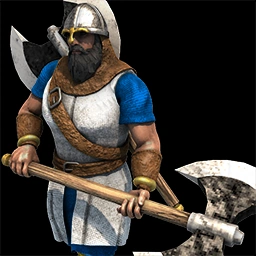
Castle Age · trains at the Castle
60 HP · 13s to train
Bonus damage against buildings.
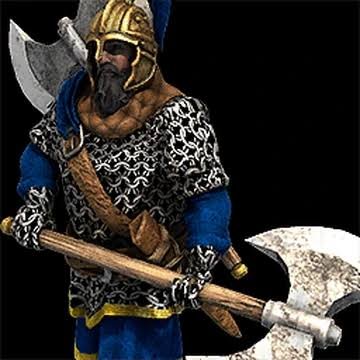
Imperial Age · upgrade 850 food, 550 gold
70 HP · 13s to train
The Franks' answer to having no Arbalester.
| Stat | Throwing Axeman | Elite |
|---|---|---|
| Hit points | 60 | 70 +10 |
| Speed | 1.0 | 1.0 |
| Training time | 13s | 13s |
| Attack type | Ranged | Ranged |
| Armour class | Infantry | Infantry |
| Bonus damage | vs buildings | vs buildings |
| Range with Bearded Axe | +2 | +2 |
| Upgrade cost | — | 850F 550G |
The frame delay is the catch. Throwing Axemen have a noticeable wind-up before the axe leaves the hand, so they lose damage every time the target moves and they are punished hard by hit-and-run. That, plus modest range even after Bearded Axe, is why they support Knights rather than lead. Where they shine is against the anti-archer units: because they are classed as infantry with a ranged attack, Skirmishers and Huskarls have no bonus against them at all.
Skirmishers, Huskarls, Rattan Archers, War Wagons and other anti-archer units, buildings, and Rams — which they can kill from behind a closed gate.
Hand Cannoneers, Onagers, Cavalry Archers and anything that can kite. Standard infantry counters apply too, since the game treats them as infantry despite the ranged attack.
Honest assessment
The Franks are the easiest strong civilization to play and the hardest to play badly — up to about minute thirty-five, when the gold runs low and the plan runs out.
Three openings worth learning
These are the three most popular AoE2 Franks build orders on the ladder: the Fast Castle into Knights that defines the civ, a Scout opening for open maps, and the forward Castle drop that only Franks can afford this early. Villager numbers are cumulative — villager 11 is your eleventh, counting the three you start with.
Why Franks make this build look easy: every other civ pays 275 food and 75 wood for Horse Collar, then 375 food and 125 wood for Heavy Plow. You pay nothing and get both automatically. That saving lands during precisely the window where a Fast Castle is starved for resources, which is why the Frankish version of this build reaches Castle Age comfortably while doing less optimisation than anyone else has to.
Villagers 1–6
Two houses, then all six to sheep.
Villagers 7–10
To wood with a Lumber Camp.
Villager 11
Lure the first boar.
Villager 12
House, then Mill on berries.
Villagers 13–15
Berries. Lure the second boar with the last of them.
Villagers 16–18
Food under the Town Center, then farms as the sheep run out.
Villagers 19–21
Split between wood and gold. Build the Stable with a wood villager.
Feudal Age
Loom, then click up at ~21 pop. Start Scouts the moment you land.
In Feudal
Three to five Scouts, then a second Stable if the raid is landing. Your Scouts have +20% hit points, so they survive Spearman contact far better than usual.
Castle Age
Click up behind the pressure and transition straight into Knights. Do not over-invest in Scouts — they are a tempo tool, not the win condition.
The bonus that makes this work: the +20% hit point bonus applies from the Feudal Age and covers all mounted units, so Frankish Scouts are noticeably tankier than the version every other civ fields. They trade up against Spearmen and survive tower fire long enough to actually leave. That said, the Franks still lack Bloodlines, so your Scouts are behind a Bloodlines civ's Scouts — you are ahead of the field, not ahead of everyone.
Villagers 1–12
Standard Fast Castle opening — sheep, four to wood, boars, Mill on berries.
Villagers 13–18
Berries and food under the Town Center. On Arena you will have more bushes than usual, which suits the forage bonus.
Villagers 19–22
Wood and gold. Put four onto stone as soon as the Mining Camp is up — this is the part that differs.
Feudal Age
Loom, click up, then Market and Blacksmith while advancing to Castle.
Castle Age
You need 553 stone, not 650. Walk three or four villagers forward and drop the Castle just outside the opponent's base.
After the drop
Produce Knights from Stables at home and Throwing Axemen from the forward Castle. Add Bearded Axe so the Axemen out-range what comes to clear them.
If it stalls
The Castle still pays for itself as map control. Fall back, take the extra Town Centers, and play the standard Knight game with a forward fortress you already own.
Read the discount carefully. The Castle Age discount is now 15%, not 25% — it was reduced in Return of Rome, and a lot of guides still quote the old number. So your Castle Age drop costs 553 stone, and only in Imperial does it fall to 488. That is still the cheapest Castle in the game and it still enables drops nobody else can afford at that timing, but budget for 553, not 488, or you will be a full mining trip short.
Playing the civ, age by age
Every Franks game is the same shape: reach Castle Age healthy, convert Knights into map control, and close before the gold runs out. The skill is in the closing.
Age I–II
~9:00 – 16:00
The Franks have no Feudal Age power spike, so Feudal is a corridor, not a destination. Either wall and take the Fast Castle, or make three to five Scouts to buy time. Both are correct; the map decides.
Skip Horse Collar. It arrives free. New Franks players research it by reflex and hand the opponent a thirty-second lead for nothing.
Age III
~16:00 – 26:00
This is the civilization. Two Stables, constant Knights, and raid continuously — the +2 line of sight exists so you can see the Pikemen before you ride into them, so use it. Take Bloodlines off your mental checklist permanently; you cannot research it.
A forward Castle at 553 stone is the Frankish special move. It denies map control, produces Throwing Axemen on the spot, and gives raiding Knights somewhere to retreat to. Add Bearded Axe only if you are genuinely committing to Axemen.
Age IV
26:00 +
Paladin plus Throwing Axemen or Hand Cannoneers, with Bombard Cannons for anything that hides behind stone. Take Chivalry early — it cuts roughly 68 seconds off the Paladin upgrade and then keeps replacing losses at 40% faster.
Heavy Scorpions pair beautifully with Paladins if you can afford them. What you must not do is let the game reach a trash war: no Hussar, no Bracer and no Ring Archer Armor means Frankish trash units lose to almost everyone's. Every minute after your gold runs low is a minute you are losing.
Any age
Scouting notes
Assume Knights and prepare before you see them. Pikemen into Halberdiers and Camel Riders are the answer, and unlike most matchups you can commit to them early because the Franks have no archer plan to punish you with.
Then take the game long. Their economy bonuses expire, their trash units are poor, and their towers are weak without Keep or Bombard Tower. Monks work, but check for Heresy first — the Franks have it, so conversions may just be kills.
Watch a pro break it down
Worth watching precisely because it is organised differently from the section above. Where this page walks the ages in order, DauT splits the civilization by who you are facing — how the Frankish game changes from Dark Age to Imperial against a cavalry opponent, and then the same run-through against archer civilizations. That second half is the useful one, because archer civs are exactly the matchup where the Franks' missing Arbalester and Bracer start to bite and Knights alone stop being an answer.
Civilization guide · chaptered by matchup DauT Open on YouTube
What you can and cannot build
Strikethrough entries are what the Franks do not get. The pattern is deliberate: everything that makes cavalry work is present, and almost everything that would let you survive without cavalry is missing.
Paladin is the best in the game thanks to +20% HP. No Bloodlines is the trade, and no Hussar hurts in a trash war.
A genuinely full infantry tree on a cavalry civ. The Long Swordsman opening is a real option against early Pikemen.
The worst archery range of any strong civ. Hand Cannoneers are the only unit here worth massing, and Throwing Axemen exist to cover the gap.
Every cavalry and infantry upgrade is present. Both missing techs are archer techs — and Bracer's absence also weakens towers and ships.
Average rather than bad. Bombard Cannon plus Siege Engineers is enough to open a base, and Heavy Scorpions screen Paladins well.
Cheap Castles are the whole defensive plan, because the tower line stops early and never gets Bracer to compensate.
No naval bonus and three missing technologies. On water maps, lean on cheap Castles near the shoreline instead of contesting the sea.
Heresy matters more here than almost anywhere: it stops Monks stealing your Paladins. The economy tree is complete but has no late-game multiplier.
Where the Franks appear
No civilization gets more screen time. The Franks are playable in ten campaign scenarios — eleven if you count the hidden one — and they have more AI appearances than anyone else as well.
The Age of Kings · 6 scenarios
1429–1431 · Hundred Years' War
The full Frankish campaign, and the one most players meet second after William Wallace. Six scenarios: An Unlikely Messiah, The Maid of Orléans, The Cleansing of the Loire, The Rising, The Siege of Paris and A Perfect Martyr. Narrated by Guy Josselyne, a knight the designers invented.
Tip: It is harder than its one-sword rating suggests, because the enemy is Britons and Longbowmen out-range everything you own. Do not try to win at range — you cannot. Force the close fight with Knights, and use a Castle to absorb the aggro while your cavalry gets in.
Battles of the Conquerors · co-op
732 · Charles Martel vs the Umayyads
The deepest cut into actual Frankish history the game makes. In the co-op version both playable factions are Franks.
Tip: Enjoy the irony while you play it — see the history section below. The real Frankish army at Tours won on foot.
Battles of the Conquerors · co-op
1066 · Norman conquest of England
You play the Normans as Franks — descendants of Norse settlers in Francia, which is a reasonable enough call. Both playable factions are Franks in the co-op version.
Tip: The scenario rewards combined arms far more than the rest of the Frankish material does. Cavalry alone will not break a shield wall here, which is historically apt.
Victors and Vanquished
768–814 · Carolingian expansion
The Franks at their actual historical peak, rather than as a stand-in for medieval France. If you only play one Frankish scenario for the history rather than the gameplay, make it this one.
Tip: Pairs naturally with Tours — Charles Martel was Charlemagne's grandfather, and the two scenarios bracket the rise of the Carolingians.
Victors and Vanquished
Early Capetian France
The fifth playable Frankish scenario, and the least played of the set. Worth a look if you have finished Joan of Arc and want more of the same civilization with a different problem to solve.
Tip: Like most Victors and Vanquished maps, it assumes you already know the fundamentals. Do not start here.
Elsewhere
Beyond those, the Franks turn up as allies or enemies across a large share of the campaign catalogue — more AI appearances than any other civilization. If a European scenario needs a generic Christian kingdom, it is usually the Franks.
Tip: Their wonder is Chartres Cathedral, and Frankish units speak Middle French — with a modern accent that would have baffled anyone alive at the time.
Design versus record
The Franks are the most historically confused civilization in the game — and one of the most accurate, depending entirely on which bonus you look at.
In the game
A Castle-trained infantryman who hurls axes, available from the Castle Age through to the end of the game.
In history
The francisca was genuinely Frankish — and genuinely obsolete by the time the game begins. It belongs to the Merovingian Franks of the fifth and sixth centuries; it had fallen out of use long before Charlemagne, let alone Joan of Arc. The in-game axe is also a hefty double-bitted thing, where the real francisca was small and single-bitted.
Verdict: a real weapon dragged forward roughly eight hundred years to give the civ a unique unit.
In the game
Horse Collar, Heavy Plow and Crop Rotation all arrive automatically.
In history
Those three technologies map almost exactly onto the agricultural changes of the Carolingian period: the horse collar that let horses pull ploughs, the heavy mouldboard plough that broke northern European soils, and three-field rotation. The Frankish surplus is what paid for the Frankish army.
Verdict: the best-researched bonus on the civilization, and hardly anyone notices.
In the game
+20% hit points on mounted units, the best Paladin in the game, and a Tours scenario to play it in.
In history
Frankish heavy cavalry really did become the template for European knighthood under the Carolingians. But at Tours in 732, Charles Martel's army fought and won on foot, in a close infantry formation that absorbed the Umayyad cavalry. The game hands you a cavalry civ and a Tours scenario, which inverts the battle that made the Franks famous.
Verdict: right about the Franks in general, wrong about the one battle it dramatises.
In the game
553 stone in Castle Age, 488 in Imperial, against 650 for everyone else.
In history
Fortification in France proliferated dramatically from the tenth century onward, first as timber motte-and-bailey works thrown up quickly and cheaply, later in stone. Castle-building was so bound up with local power that royal authority spent centuries trying to regulate who was allowed to do it.
Verdict: accurate, and it produces the civ's most interesting strategic option.
In the game
Six scenarios set in 1429–1431, played as the Franks in blue.
In history
The Franks were a Germanic people whose realm gave rise to France, Germany and northern Italy alike. By Joan's lifetime they had been gone for five hundred years. The civilization collapses about a millennium — Clovis, Charlemagne, Hastings and Joan of Arc — into one blue banner.
Verdict: a deliberate simplification, and the reason "Franks" and "French" get used interchangeably by players.
In the game
Middle French vocabulary, delivered in a recognisably modern accent.
In history
The guttural French "r" that makes the voice lines sound French to a modern ear only emerged around the eighteenth century. The actual Franks spoke a Germanic language; Old French developed later from Latin in their territory. It is an anachronism the designers almost certainly chose on purpose, because the alternative would not read as French at all.
Verdict: wrong, knowingly, and the right call for a game.
Quick answers